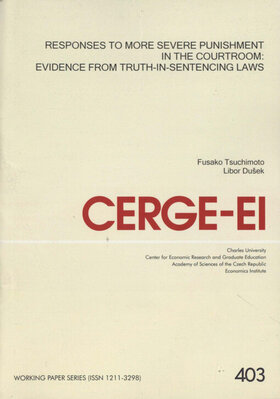
Responses to more severe punishment in the courtroom: evidence from truth-in-sentencing laws
edice: Working paper series (403)
We investigate behavioral responses of judges and prosecutors to more severe punishments by analyzing the effects of Truth-in-Sentencing (TIS) laws in a large sample of individual criminal cases. ...
We investigate behavioral responses of judges and prosecutors to more severe punishments by analyzing the effects of Truth-in-Sentencing (TIS) laws in a large sample of individual criminal cases. The TIS laws raised effective punishment by requiring offenders to serve at least 85% of their imposed sentence in prison. Differences between the U.S. states in the timing of adoption and the types of crimes covered provide a source of identification. The key findings are: (1) The TIS laws reduced the probability that an arrested offender is eventually convicted by 25% through an increase in the probability that the case is dismissed, a reduction in the probability that the defendant pleads guilty, and a reduction in the probability that the defendant is convicted at trial. (2) The TIS laws the reduced the imposed sentence that a defendant may expect upon arrest by 14%. The behavioral responses are empirically important to partially mitigate the intended deterrent effect of the TIS laws.
číst celou anotaci
nakladatel: Univerzita Karlova, Centrum pro ekonomický výzkum a doktorské studium
vydána: 2009, Prague
vazba: brožovaná, 45 stran
jazyk: angličtina
ISBN: 9788073432058
(OCoLC): 649799310